Which grounded theory?

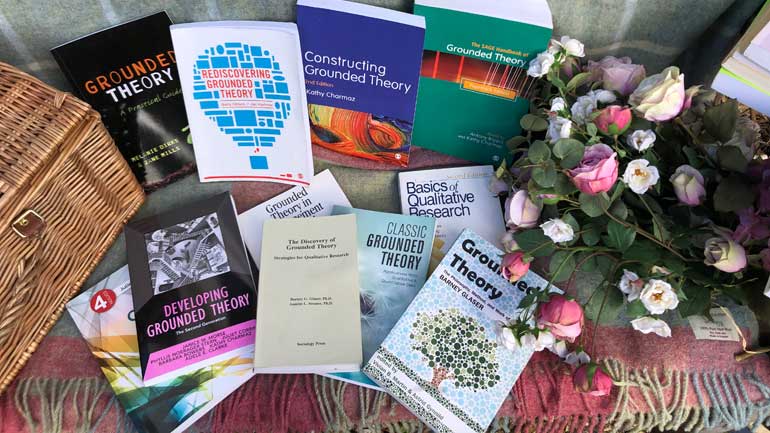
Which type of grounded theory should I use?
The version or type of grounded theory that is right for your study depends on what you want from your theory: a conceptual tool for change or a sociological story?
Conceptual tool for change or sociological story?
Classic grounded theory will enable you to generate a theory which can be used as a conceptual tool that can be applied – used – to bring about managed change e.g. Crisis Stewardship: What do leaders need to take action in a crisis?
In contrast Charmazian grounded theory is intended to generate a “sociological story”1, which is not intended to be generalisable or applied (Charmaz, 1991, p.7).
“The aim for the Charmazian grounded theorist is to produce “general statements” (Charmaz, 2014, p. 232) relating to an “abstract understanding of studied life” with “analyses located in time, place, and the situation of inquiry” (p. 342)” (Scott, 2025, p. 182).
For an example, see “Identity Dilemmas of Chronically Ill Men” ( Charmaz, 1994).
Philosophical perspective
The page “Reconciling grounded theory perspectives” explains:
(i) how the design of the grounded theory method renders it independent of any philosophical and theoretical perspective
(ii) that it is the perspective of the grounded theorist using the method that embeds a philosophical or theoretical perspective into a grounded theory study.
This means that anyone of any philosophical or theoretical perspective can use classic grounded theory. Choosing which version of grounded theory to use is not, therefore, a matter of choosing according to your philosophical or theoretical perspective.
I find this idea very liberating.
Many of the people that I have worked with had assumed that if they used a constructivist epistemological perspective, that their only option was to use Charmazian grounded theory. This is not the case. In my PhD, examined by Barney Glaser, social constructionism underpinned my work (Scott, 2007) and I am comfortable with a constructivist epistemology (Scott, 20022). Like me, you are free to use the classic grounded theory method whatever your theoretical or philosophical perspective .
Practical perspective
The grounded theory research method as originally conceived by Glaser and Strauss, (which I term stem grounded theory3) is a practical research tool that was designed to generate a theory grounded in data.
Since then, writings about the varieties of grounded theory have caused confusion about how to actually generate a grounded theory. What practical changes have been made to the practical research tool?
From a practical perspective, Strauss & Corbin and Charmaz offer revisions to the coding process of stem grounded theory and each offers a new theoretical code. I explain below, how the revisions to coding procedures can be set aside where unhelpful, and how the two very useful theoretical codes can be absorbed into the stem/classic grounded theory process.
1. Axial coding and the coding paradigm (Strauss and Corbin)
Straussian GT offers a wonderful theoretical code “the coding paradigm” but a problem for many would-be Straussian grounded theorists is that not all data fits this theoretical code. Axial coding is the technique designed to help analysts fit their data to the theoretical code but in those cases where the data does not fit, axial coding does not work.
The good news is that as the stem (and classic) grounded theory procedure of hand-sorting memos will enable the use of the “coding paradigm” where helpful, there is no need to use axial coding to force the data to fit into it.
2. Initial coding and the analytic framework (Charmaz)
Charmaz varies the analytic procedures of classic GT with her process of “initial coding”, which begins with summarising the data before using the conceptualising techniques of classic grounded theory’s open coding (Charmaz 2008, 2014 p.116). In practice, the act of summarising adds another layer to the coding process and leads to the generation of too many codes, slowing down analysis. I advise omitting summarising and simply using the conceptualising techniques embedded in classic grounded theory’s open coding.
Charmaz also introduces a new theoretical code, the “analytic framework”, which is used to generate a sociological story (Charmaz, 1991, p.7) (and which Glaser terms a “conceptual description”). The “analytic framework” can similarly be absorbed into classic GT procedures as another theoretical code that may or may not be appropriate for your study.
For a more detailed explanation please see the relevant sections beginning on page XV, and pages 63, 94, 110 and 139 in Chapters 3 – 6 in Using Grounded Theory: How to Develop Theory for Managed Change .
Retaining flexibility
The data collected determines the theoretical codes that will be useful, which in turn define the final shape of the theory. Strauss and Corbin offer only one theoretical code, which relies on one type of (situational) data. Similarly Charmazian grounded theory uses one type of (co-constructed) data and one theoretical code. Classic grounded theory allows for any type of data and any theoretical code from any discipline and any theoretical or philosophical perspective. This means that classic grounded theories come in many different shapes and sizes.
In order to retain flexibility to use the theoretical code that best fits the data and makes the most of the opportunity inherent in the data, I recommend using classic GT procedures in most cases.
Moving the conversation on
In 2001 I accepted Karen Locke’s invitation to grounded theorists to focus less on “vindicating their choice of analytic procedure” and focus more on providing “a better understanding of how a particular study progressed” (Locke, 2001 pp. 128 – 129)” (Scott, 2007, Chapter 3). Similarly, I invite you to focus more on choosing your method based on what you want to achieve with your grounded theory – and then explaining the philosophical or theoretical perspective that you bring to your grounded theory study.
My book “Using Grounded theory: How to develop theory for managed change” is a super-practical and very colourful book, which illustrates and explains how to operationalise classic GT procedures with examples from mentees. For those who are interested, the discussion and explanations above are expanded and threaded throughout the book.
Helen Scott PhD
Grounded Theory Online
August 2025
1 Note that classic grounded theory will also enable you to generate a sociological story, which differs from a Charmazian sociological story by being “abstract of time, place and people” (Glaser, 2005, p. 80) and thus can be applied.
2 Scott, H.M.P. (2002) A Learning Community in Cyberspace [Unpublished Masters dissertation] University of Portsmouth.
3 Stem grounded theory refers to grounded theory as originally conceived and as presented in The Discovery of Grounded Theory (Glaser & Strauss, 1967) and Theoretical Sensitivity (Glaser, 1978) (Scott, 2025, p. xviii)
© 2025, Helen Scott PhD, Grounded Solutions Ltd. All rights reserved.
